Essay
Distribution Trumps Innovation: How to Win in Emerging Markets
Why great products stall in emerging markets without trusted distribution, and how partners like telcos win customers' trust

TL;DR
In emerging markets, distribution trumps innovation: a great product without trusted channels to reach customers will cost a company time, money and opportunity. André de Wet draws on PriceCheck's award-winning app, which still took about a million dollars to reach a million downloads, and iflix's African launch, where telco partnerships bought time to fix the content, to argue that these low-trust, mobile-first markets reward local product fit and partners that customers already trust. His plan to win: know your competition, localise for every market, build trust with every stakeholder, make distribution the first priority and partner with someone your end-user already trusts.
I'm frequently approached by local entrepreneurs and international players looking to branch out into emerging markets. Mostly, they have great ideas, great products and, most probably, real solutions to real problems, although some are more relevant than others. But in my experience, having a solution isn't enough. Let me explain that "but".
What did an award-winning app teach me about distribution?
Back in 2013 I was CEO of PriceCheck, the largest price-comparison site in Africa. We'd built one of the first bar-code-scanning mobile shopping apps, which took the all-important step of creating a crossover between the online and retail (offline) worlds of shopping. At the time, most businesses internationally were building either online commerce or digital tools for physical stores. Very few were combining the two.
That led to us being named mobile app of the year, internationally. Yep, we beat 150,000 other entrants, and we were feeling very impressed with ourselves.
I went to Orlando to collect the award, got quite a bit of front-page press back home and felt very "arrived". Flying back into South Africa, I was under the firm belief that everyone who was anyone would now be downloading our app.
But… nothing. There was a small uptick and then, after a week or two, back to normal numbers. It taught me a very, very important lesson: distribution is the key to success in emerging markets.
For context, we did get to a million downloads in the year after the award, but it cost us probably the better part of a million dollars to get there. And PriceCheck was part of a large local media house, Naspers, so we had the benefit of a budget and a media platform we could use to get our message out.
We had a world-class app. Without a decent distribution network, or a large budget, we would have had a world-class problem.
Why does distribution trump innovation?
Distribution is how a product actually reaches its customers: the channels, partners and relationships that put it in their hands and give them a reason to trust it. Here's the key message: distribution trumps innovation, any day of the week.
If you don't have your distribution methods and channels worked out very well, and in advance, it's going to cost you time, a ton of money and opportunity. Even throwing cash at the problem might not work if you're not sure where and how to handle emerging markets, emerging economies and their distribution networks.
The good news is that if you get it right, vast new audiences with disposable cash and buying intent await.
Why can't you treat emerging markets like established ones?
Lesson one: emerging markets are very different from other markets. Do not treat them the same. That counts as strongly for product fit as it does for how you get the product to, and into, a customer's hands.
In terms of product fit, I'm sure you've proven consumer demand in a market, tested and possibly successfully launched your product. But realise that every market will respond differently. It might seem I'm stating the obvious, but too many times I find international players (read: established-market companies) think that all they need to do is copy what worked in the US or Europe and it will fly in emerging markets, in Africa and Asia alike.
In Asia specifically, the way local players copied, perfected and then overtook established companies is a great example. Just look at how companies such as GoJek, DiDi Chuxing and Grab came to dominate app-based ride-hailing and delivery in their markets, way ahead of international giants like Uber. And that is just one example; there are multiple others. These companies used their understanding of the local market and their customers, and the fact that every country in their region responds differently and has different needs, to go to market successfully.
If you're looking to expand or grow in an emerging market, you're going to have to know how to target differently in every market. No easy replication is going to deliver results. Every market needs to be approached with effort and discipline.
What did launching iflix across Africa teach me about local fit?
I saw this need for market-specific strategies and plans while rolling out the video-on-demand service iflix across Africa. We initially came into the market with top-quality Western content that looked good in launch articles and press releases but hardly worked on the ground. Sure, the titles got people's attention when we launched, but it soon petered out. What customers were looking for was local content, and lots of it.
That misstep in content didn't stop us from exceeding our go-to-market projections, though. Our saving grace? We got the distribution right, and very right. We'd partnered with mobile phone operators (telcos) across Africa and could get our product into millions of users' hands. That gave us the (small) luxury of time to fix the product.
A very unusual find was how much Korean telenovelas were enjoyed in Ghana and Nigeria. What makes it even more unusual is how we found out.
In Nigeria there is an informal market called the Alaba market that sells almost anything electronic, and that includes DVDs, almost all of them pirated, to the tune of as many as a million DVDs a week. Similar markets exist across Africa.
Instead of trying to study the popular movie titles of the week through formal channels, all you need to do in Nigeria is see what is selling in the Alaba market to determine what should be featured on an OTT streaming app.
So that's exactly what we did. When we found that Korean telenovelas were the most popular pirated DVDs, we went looking for those titles, and our content team secured the rights. It helped that iflix was already featuring Asian content, so we just had to secure an extension of the rights. We got them for peanuts, because the distributor didn't think there was any value in the African rights. Local knowledge = win.
What comes first: product fit or distribution?
The first task is to bring, create or build a product that will work for the local market and solve a local problem, or make something local easier.
Once you've thought that through, planned accordingly and achieved product fit, the biggest next challenge is distribution. You might have the greatest tech and the best plans, but you need to know how to reach the right audience. If you don't play clever and know who you're dealing with, it's going to be very (very) difficult to get them.
Why is trust the real barrier in emerging markets?
The key lies in the complexity of trust, which is especially prevalent in emerging markets. Emerging markets are very low-trust environments. That applies to all the parties you need to deal with, from users and consumers to regulators and banks, and almost every other stakeholder.
How you win and establish that trust, throughout the value and delivery chain, is going to be a key part of your strategy. The adoption of new tech, and more so of mobile and internet businesses, has been very different in emerging markets compared with established markets. Treat them accordingly.
Why isn't mobile-first the same as app-first?
Most African markets got their first real feel for the internet through mobile, so play in that arena. But don't make the mistake of thinking that means just a clever mobile app. There is very little trust in app stores, and most phones don't have enough memory to keep downloading apps. And don't forget that in emerging markets a download costs data, and data costs real money. Oh, and how would a customer know (trust) that your app isn't going to use masses of data once it's on their phone? You've got to educate accordingly.
Just because the device is a mobile doesn't mean the app is king. After we'd spent a ton of money getting users to download our "award-winning" PriceCheck app, we learnt that as much as 75% of our traffic was coming from the mobile web, not our app. The mobile web used less memory, and there was no threat of an app chewing through data unexpectedly, so it felt like the safest option to our African user base. The lesson: make sure you optimise across all platforms.
Where do you find trust and distribution?
Successful tech in these large markets is successful because of distribution.
This is where new entrants need to get clever and play differently. Established first-world channels to market can be very expensive per download, and for awareness, education and building trust. So thinking a little more locally, using contacts, relationships and hands-on effort, starts to work.
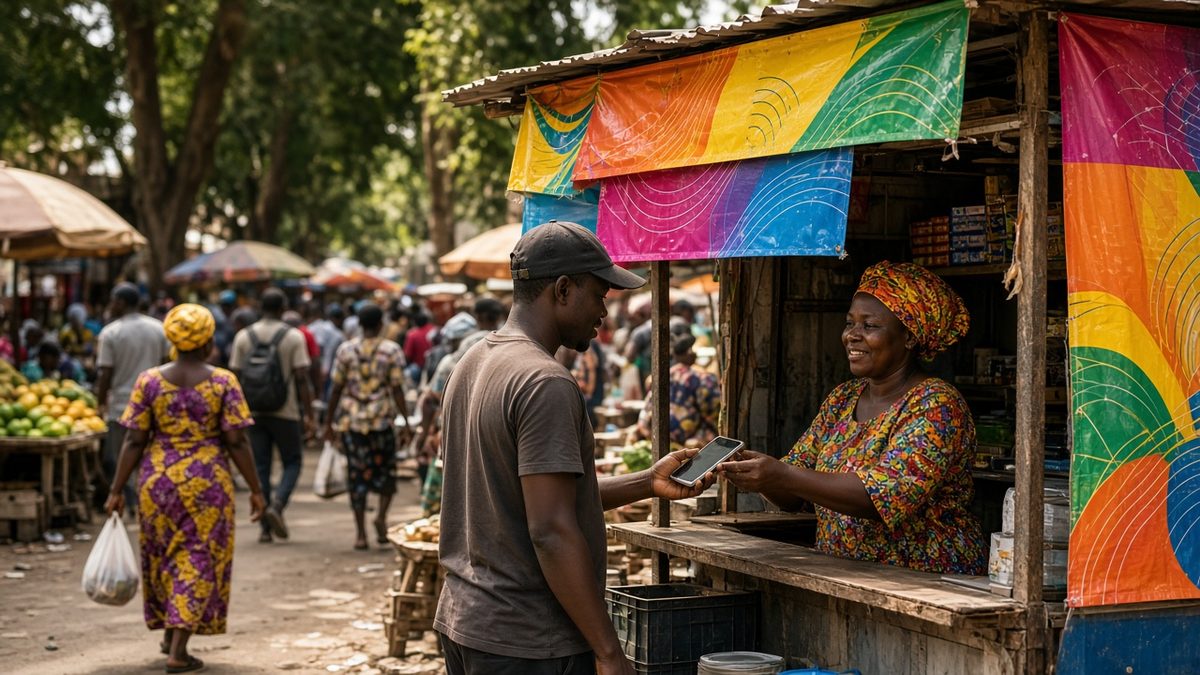
Where would you get trust, and where would you get distribution? There's nowhere better to build trust than through and with traditional players such as older media houses and, more recently, telcos. As telcos become such a strong channel, you can see why the argument for a telco super-app starts to make sense: one login, one app, one trusted relationship, lots of services and options. This wouldn't currently work in the US or Europe but, as WeChat has proven in Asia, it works very well in emerging markets.
So the first step is to reach a minimum level of quality. Then partner with a good distribution partner while bringing in media at the same time, but keep those two roll-out strategies closely aligned and in sync.
In this war, the battle will be won by the one with the best distribution.
What is the plan to win?
- Know your enemy. Determine who you're competing with for a customer's attention.
- Personalise your product for the country, territory or clientele. Understand why customers might move to your product. Understand and perfect what you're building for each market, each country and each business case.
- Build trust. Spend time understanding the ecosystem and building trust with key stakeholders.
- Make distribution the number one focus. You are in the distribution game.
- Partner with someone your end-user trusts, and then use them to get your product to market. It's hands-down the fastest and best way to expand.
What are the myths and truths of emerging-market expansion?
- "Build it and they will come" will not work.
- Trust is key: trust in your platform, or in the network you use. A win is when you get both.
- Educate: explain how your thinking, your product and your system work, and what they will bring. Do not assume anyone understands.
- Find the local use: what will your users actually use your product for, and what problem are you solving locally?
- Emerging markets are mobile-first: think and grow that way, but don't make the mistake of thinking that mobile means "app".
How do you win the distribution game?
- Build trust.
- Use a trusted platform such as a telco or a media house.
- If you're commoditised, it will come down to price.
- Super-app thinking allows the trust factor to build on top of another level of trust.
- Once you cross that threshold of trust, it will equal success.
- Beware of your innovation getting ahead of local regulation.
The takeaway
Thanks to technology, the world is getting smaller, and we're taking our companies and products to places that only a few years ago didn't have access to even the most basic internet connection.
So don't think you'll be the new best thing, or the knight in shining armour. These markets aren't waiting for you to save them. They are waiting for you to earn their trust, understand their challenges and solve their problems. That takes empathy, effort and a killer distribution network.
For the sheer size of the market and the next billion users, it's worth making the effort.
A shorter version of this article was first published on Forbes (Forbes Business Council) on 5 July 2021. This is the full version. Follow André on LinkedIn →