Essay
Subscription: It Just Arrives
How subscription commerce turns repeat shopping into something that simply arrives, and gives online retailers predictable monthly revenue

TL;DR
Subscription commerce means selling products on a recurring schedule, so the customer decides once and the order just arrives. André de Wet argues that subscriptions for everyday household essentials are the strongest revenue engine an e-commerce site can build, and the membership warehouse clubs show why: in fiscal 2026 Costco's membership fees were equivalent to about half its operating income, and around nine in ten of its members renewed. Add curated boxes, brand-funded samples and the ritual of unboxing, and the parcel becomes a media channel as well as a delivery, provided the retailer delivers real savings, reliable service and a cancel button as easy to find as the sign-up.
Most e-commerce businesses rent their customers. They pay to acquire a shopper, win one basket, and then pay again to win the next one. Every month starts at zero.
I've spent most of my career on the demand side of digital commerce. I built PriceCheck into Africa's biggest price-comparison platform, which taught me how quickly a shopper moves when the only reason to choose you is price. I ran Africa for iflix, a subscription streaming business, where revenue arrived every month or it didn't arrive at all. And through my advisory firm 2ndBase, which I founded in 2018, I've worked with retailers on digital commerce strategy, including subscription models.
The conclusion I keep coming back to is simple. The most valuable thing an online retailer can own is not the next basket. It's the monthly one. And the whole promise to the customer fits in three words: it just arrives.
What is subscription commerce?
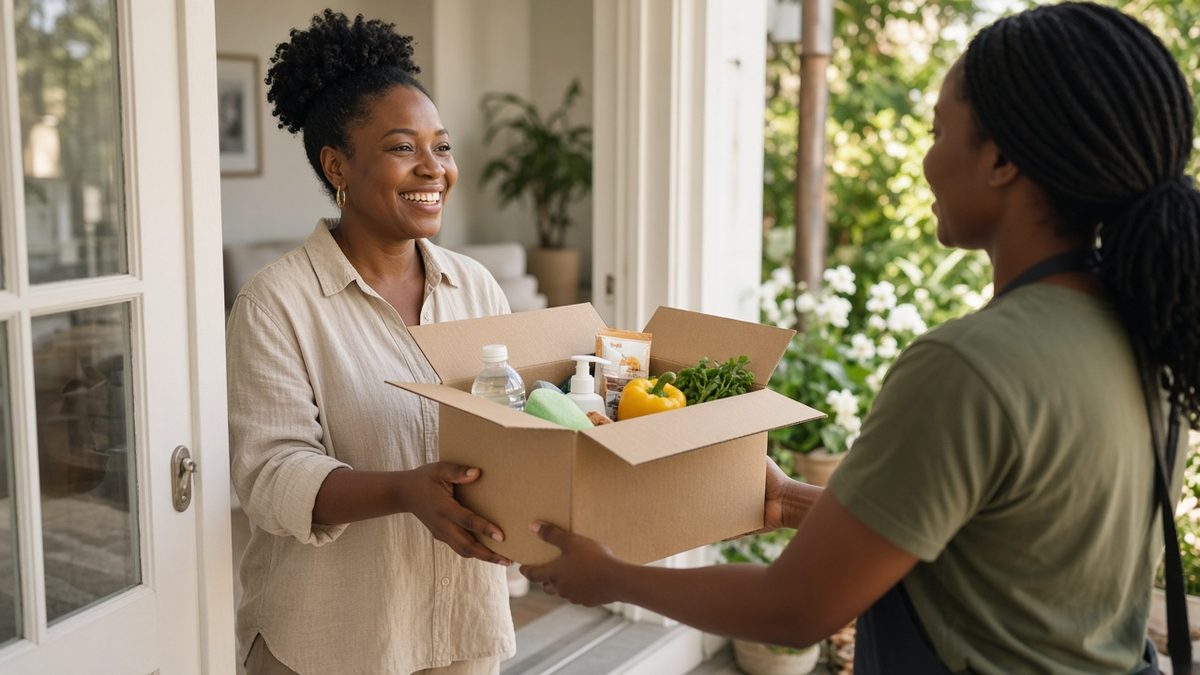
Subscription commerce is selling products on a recurring schedule at an agreed price, so the customer decides once and the retailer fulfils automatically. Instead of a shopper remembering, searching, comparing and checking out every time they run low, the order simply repeats until they change it. It just arrives.
It works because it removes the most expensive moment in retail: the moment the customer has to decide all over again. Every repeat decision is a chance for a competitor, a promotion or plain forgetfulness to take the sale. A subscription turns that decision into a default.
McKinsey's 2018 research on US online shoppers found that 15 per cent of online shoppers had signed up for at least one product subscription. It groups subscription e-commerce into three types, and the distinction is useful for any retailer:
- Replenishment: the things a household runs out of, delivered automatically.
- Curation: a themed selection chosen for the customer, usually a monthly box.
- Access: a paid membership that unlocks prices, perks or delivery.
The membership warehouse club is the classic version of access, and digital commerce lets you combine all three in one relationship.
What do Costco and Sam's Club prove about recurring revenue?
The warehouse clubs are the clearest proof that a retailer can be paid for the relationship, not just the basket. Customers pay an annual fee for the right to shop, and the retailer earns loyalty before a single product is sold.
The numbers are worth reading slowly. In its fiscal year to 30 August 2026, Costco reported in its annual report:
- $5.9 billion in membership fees, up 11 per cent on the year, out of total revenue of $303.2 billion. Fees were less than 2 per cent of revenue.
- $11.7 billion in operating income. Membership fees were equivalent to roughly half of that figure.
- 84.1 million paid members (150.4 million cardholders including household cards), of whom 42.3 million held the higher-fee Executive membership. Executive members accounted for about 75 per cent of worldwide net sales.
- A member renewal rate of 92.3 per cent in the US and Canada, and 89.8 per cent worldwide.
Merchandise costs absorbed about 89 cents of every dollar of Costco's net sales that year, according to its fiscal 2026 results. The goods are sold on thin margins; the membership pays a large part of the profit; and roughly nine in ten members come back to pay it again.
Sam's Club, Walmart's warehouse club, tells the same story at a different scale. In Walmart's fiscal year to 31 January 2026, Sam's Club US reported $93.0 billion in net sales, $2.5 billion in membership and other income and $2.4 billion in operating income. Walmart's annual report says that, as a membership-only club, membership income is "a significant component of the segment's operating income", and it attributed the 8.7 per cent rise in membership and other income to growth in the membership base and in Plus, its higher-fee tier.
The behaviour shows up in pure subscriptions too. Walmart told investors in May 2026 that members of Walmart+, its delivery subscription, generally spend four times more than non-members and make seven times more e-commerce visits a year. Some of that is selection, because the most engaged shoppers are the likeliest to join. But that is the point: a membership finds your best customers and keeps them close.
The basket brings the customer in. The renewal pays the bills. An online retailer doesn't need warehouses to borrow the lesson. A monthly essentials subscription is the same idea delivered to the door: the customer commits once, and the retailer earns the right to the next month.
Why do subscriptions work so well for monthly essentials?
Nobody wakes up excited to buy toilet paper. That is exactly why it is the best subscription product there is.
Household essentials have three properties that make them ideal for recurring delivery:
- They are bought on a rhythm. Toilet paper, shampoo, body wash, dishwashing liquid, cleaning products, feminine care and baby essentials run out at a predictable pace.
- They are low-involvement. Shoppers don't want to browse for them. They want them to be there.
- Running out is a real cost. The mid-week panic buy at the corner shop, at full price, is the moment a retailer loses the customer's loyalty to whoever is closest.
A replenishment subscription removes that moment. The customer builds a monthly basket once, sets a delivery cadence (weekly, fortnightly or monthly), and the retailer processes, bills and delivers automatically. Set it. Forget it. Never run out.
The promise to the customer is easy to state:
- Save: subscription pricing that beats buying the same items one order at a time.
- Free delivery: on every subscription order.
- Zero effort: you never add toilet paper to a cart again; it just arrives.
- Always stocked: essentials on hand, so there's no mid-week panic buy.
- Full flexibility: pause, skip, swap, add or cancel anytime, without friction.
How do subscriptions change the economics of an e-commerce site?
Subscriptions don't just add revenue. They change the economics of the whole business. I see six shifts.
1. Recurring revenue. Monthly recurring revenue (MRR) is the revenue a business can expect every month from its active subscriptions. A subscription base produces that income regardless of campaign spend. The arithmetic is the most important formula in the business: subscribers × average monthly basket × 12 is revenue you start the year with, before a single campaign is run. Marketing stops being the thing that creates revenue and becomes the thing that grows it.
2. Loyalty that isn't bought with discounts. Competing on price alone is a race to the bottom, and customer acquisition costs keep rising across channels. A subscriber isn't comparing prices every week. Every month they stay is a month you didn't have to win them back.
3. Demand forecasting. When you know what a household will need, you know what to stock weeks ahead. That means fewer stock-outs, less dead stock and lower carrying costs.
4. Supplier leverage. Predictable volumes are worth something to brands. A retailer that can commit to steady monthly demand negotiates from a stronger position than one that can only promise campaign spikes.
5. First-party data. A subscription tells you what a household needs before it needs it. Over time, that becomes the deepest consumption data a retailer can hold: what each household uses, how fast, and what they add when prompted.
6. Differentiation. In markets where the large players compete on range and speed, a trusted, well-run essentials subscription is a position a retailer can own rather than chase.
The shift underneath all six is from transactional to habitual buying. A one-off order is a sale. A subscription is a relationship with a delivery date.
Replenishment or curated boxes: which should a retailer offer?
Both, because they do different jobs.
The replenishment subscription is the engine. It is unglamorous and it carries the volume: a guaranteed basket and a guaranteed repeat visit every cycle. Margins on everyday essentials are thin, as the warehouse clubs show, so the value lies in frequency, predictability and the data, not in the mark-up on any single item.
The curated box is the delight. Fixed price, variable surprise. A retailer curates themed boxes of full-size products each month, such as wellness, home and living, men's grooming, baby, student essentials or pampering. Unboxing culture meets everyday value. Boxes can carry better margins than essentials, and they turn a utility relationship into something people talk about.
The combination is what creates the relationship: one product that customers rely on, and one they look forward to. And once a box is arriving every month, it can carry more than the retailer's own products.
Why is the subscription parcel a media channel?
Every subscription parcel lands in a home that chose to receive it, on a day the household expects it, and is opened by the person who does the buying. Very few marketing channels can say that.
That makes the box valuable to brands that aren't the retailer. A brand looking for new customers can pay to put something in front of exactly the right household:
- Samples and trial sizes: a new shampoo in the baby box, a new snack in the student box, matched to what the household already buys.
- Brand-funded inclusions: a supplier covers the cost of a product in a curated box in exchange for the introduction.
- Inserts and offers: a card or code that invites the subscriber to try something, with the response traceable back to the box.
- Launch partnerships: a brand introduces a new product to subscribers before it reaches the shelf.
For the retailer, that is a new revenue line: supplier-funded sampling and marketing that helps pay for the box, the delivery or the subscriber's saving. For brands, it can be a cost-effective way to reach a target customer, because the retailer's first-party data says who that customer is. For the subscriber, done well, it is a small gift in every parcel.
The rule is the same as for any media: relevance is the product. A sample that matches the household is a discovery; a flyer that doesn't is litter. Keep inclusions few, useful and clearly chosen for the person opening the box, and treat subscriber data with care. Brands get the audience, not the customer's personal details.
Why does unboxing matter so much?
There is magic in unboxing, and it isn't a gimmick. It is how a subscription keeps its emotional value long after the novelty of signing up has worn off.
The paradox of a great replenishment service is that success makes it invisible. When the toilet paper just arrives, the customer stops noticing, and what goes unnoticed is easy to cancel. The unboxing moment is the answer: it gives a predictable delivery a reason to be looked forward to.
Four things are at work:
- Anticipation. A known delivery date gives the customer something to look forward to rather than something to remember.
- Ritual. Opening the monthly box becomes a small habit of its own, and every repetition reinforces the subscription.
- Discovery. A curated item or a well-chosen sample adds surprise to the reliable.
- Shareability. People photograph and post a good unboxing, which turns subscribers into a way of reaching new ones.
That is how the pieces fit together. The replenishment basket earns trust. The curated box adds delight. Partner samples bring brands and new revenue. And the unboxing keeps the relationship feeling like a treat rather than a utility bill. Reliability earns the renewal. Delight earns the recommendation.
Why do subscription programmes fail?
The model is powerful, but it is not forgiving. McKinsey's research found that churn rates are high and that consumers quickly cancel services that don't deliver a superior end-to-end experience. A subscription isn't a lock-in. It is a promise renewed every month, and the customer audits it every time the box arrives or doesn't.
The failures I'd watch for come from a short list:
- The saving isn't real. If the subscription price doesn't beat what the customer can get by shopping around, a comparison site will tell them so.
- Delivery isn't reliable. A late essentials order is worse than no subscription at all, because the customer trusted you not to let them run out.
- Cancelling is hard. Make leaving as easy as joining. Pause, skip and cancel should be one tap. Customers who know they can leave are far more willing to sign up, and a programme that relies on trapping people is building resentment, not revenue.
- Billing breaks. Recurring billing has to work quietly with local payment methods every cycle. I've spent enough of my career in payments, from card issuing in Singapore to a payment gateway business in South Africa, to know that this is where good subscription ideas quietly fail. A failed payment is a cancelled subscription by another name.
- It's built like a project, not a product. A subscription programme should plug into the existing product catalogue and fulfilment system, not become an 18-month custom build. The work is in the plans, pricing and customer experience, not in reinventing the stack.
What should a retailer measure?
A subscription business runs on a different dashboard from a campaign business. Conversion rate and basket size still matter, but the numbers that decide whether the programme works are these:
- Active subscribers: the base that produces next month's revenue.
- Average revenue per subscriber: the size of the monthly basket, and whether it grows as customers add items.
- Churn: the share of subscribers who cancel each month. This is the number that decides everything else.
- Pauses and skips: an early warning. A pause is a customer telling you something before they cancel.
- Failed payments: involuntary churn, which is often fixable with better billing rather than better marketing.
- Customer satisfaction: a simple score after every delivery tells you whether the promise was kept.
- Lifetime value against acquisition cost: what a subscriber is worth over their life, compared with what it cost to win them.
If you can only watch one number, watch churn. Acquisition fills the bucket; churn is the hole in it.
How should a retailer launch a subscription programme?
Start small, measure the right things, then scale what works.
- Pilot. Pick a handful of high-frequency categories (toilet paper, shampoo and feminine care are obvious candidates) and soft-launch to a small group of beta subscribers. Validate three numbers: average revenue per subscriber, churn and customer satisfaction.
- Launch. Go live on the full site with a branded, mobile-first subscriber portal and a dashboard where customers manage everything themselves. Market it across email, social and paid channels, and introduce the first curated boxes.
- Scale. Bring in supplier and brand partnerships to fund and curate boxes and sampling, expand the range of themes, and consider a paid membership tier: the access layer on top of replenishment and curation.
- Optimise. Use the data. AI-driven recommendations can personalise each basket, suggest the right cadence and flag subscribers who are about to churn before they do.
The order matters. Prove the habit before you spend on the marketing.
Why does this matter more in emerging markets?
My work has mostly been in emerging markets, where the case for subscriptions is, if anything, stronger.
Acquisition is expensive, loyalty is fragile, and shoppers are rightly price-sensitive. A model that rewards the customer with real savings and free delivery, while giving the retailer predictable demand, aligns both sides. Consumers in South Africa already subscribe to meal kits, health products and curated boxes, so the behaviour is proven. What has been missing is a trusted, at-scale player for the most frequent purchase of all: monthly household essentials.
That is the opportunity. The retailer that owns the monthly essentials basket owns the customer's most predictable spend, and everything else can be sold on top of it.
The takeaway
E-commerce has spent two decades optimising the single transaction: faster checkout, cheaper delivery, sharper prices. Those still matter. But a business built only on transactions has to win its customers again every month.
Subscriptions change the question from "how do we win the next order?" to "how do we deserve the next month?" The answer is unglamorous: real savings, reliable delivery, total flexibility and a cancel button nobody needs to look for.
Subscriptions drive loyalty. Data drives personalisation. Logistics keep the promise. Get all three right, and revenue stops being something you chase. It becomes something you renew, and for the customer, it just arrives.